

Morning All,
As this year's chill accumulation season comes to an end and buds begin to move, it raises an important question:
When does chill accumulation start and finish?
I thought I'd put together some current observations on the start and end of the season, along with some of the factors that influence chill accumulation.
One area that often causes confusion is when chill accumulation actually begins. Does it start once temperatures drop below a certain point, or does it begin on a certain date?
The reality is that chill accumulation only starts once trees have entered true dormancy.
If trees are still actively growing, they haven't entered dormancy yet. Around the Riverland this season, well above-average rainfall meant many trees retained their leaves well into June and, in some cases, early July. It is reasonable to assume that dormancy began later than usual in some areas.
If we look at the three quotes from researchers below, it becomes clearer that the onset of dormancy isn't fixed to a calendar date. Instead, it is a fluid process influenced by seasonal conditions. Likewise, as day length increases and buds begin to move, we can see that the end of dormancy is now occurring across many varieties.
What is chill? - Researchers Perpective
- Kramer and Kozlowski (1979) noted that shoot apices cannot elongate, even under the most favourable environmental conditions, until true dormancy is obtained.
- Salisbury and Ross (1969) wrote that the overcoming of the rest period (dormancy) appeared to be a function of temperature, day length or both.
- The expansion of large flower parts must necessarily be dependent on a good supply of carbohydrates and water(Wilkins 1969). So, for orchardists in low chill environments, management of heat conduction into the bud wood, influencing chill accumulation, must be considered as one of the major limiting factors affecting crop yields.
It is also worth looking at the pictures sent to me by Rob Lowe. They provide an excellent example of how dormancy can be influenced at the farm level.
These photos are from a property in the Sunraysia region and show the variety Shasta. The grower was assessing the impact of defoliation timing on the trees. The earlier-flowering trees were defoliated significantly earlier than the later-flowering trees shown in the photos. As a result, those trees entered true dormancy sooner and were able to begin accumulating chill earlier.
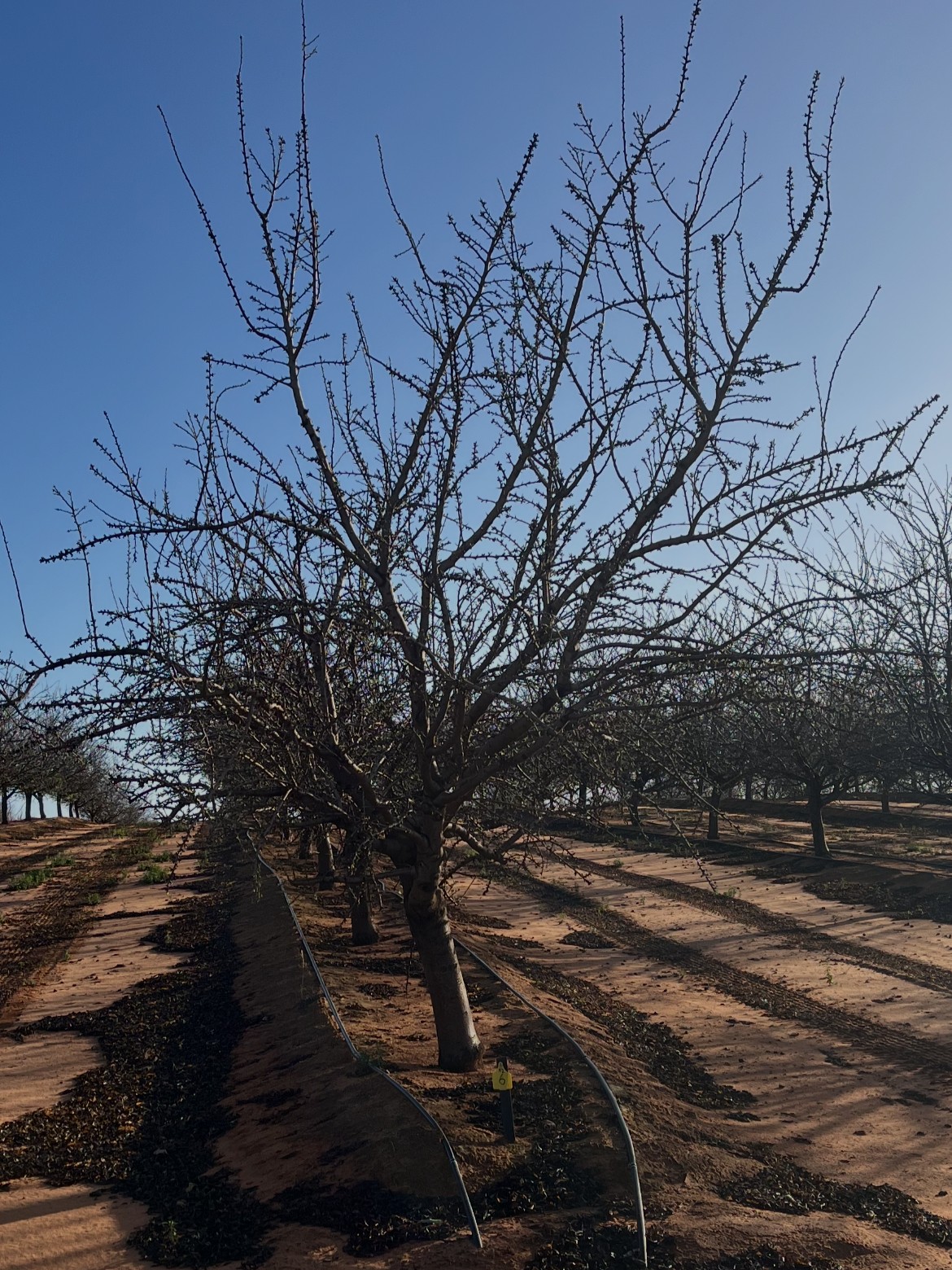
Sprayed off later.

Sprayed off earlier.
The significance of these pictures is that the onset of dormancy can be manipulated on-farm to improve the chances of successful cross-pollination. Lower chill varieties (for example, Ne Plus) can be left to grow for longer, delaying flowering. Higher chill varieties (such as Carmel) can be defoliated earlier, encouraging them into dormancy sooner so they have a longer period to accumulate the chill they require.
When we compare the graphs from the Riverland through to Griffith and the Goulburn Valley, it becomes clear how significant regional climatic differences are. Chill accumulation is not the same everywhere, and management strategies need to be tailored to both the growing region and the varieties being planted.
So where are currently at?


This season has certainly produced a few surprises:
- Geraldton Wax flowering around four weeks earlier than normal.
- Flowering Plum showing pink bud movement yesterday, when it would normally flower in the last week of July.
- Pomegranates showing no sign of bud movement.
It just goes to show that every season is different and different crops don't always follow the same pattern. If you're keeping an eye on chill on your own property, once you start seeing bud movement I'd generally call that the end of dormancy. From there, the trees are waking up and moving into their next stage of growth.
As always, keep watching what's happening in your own orchard. Your own observations are often the best guide, because no two seasons are ever quite the same.
Regards,
Shane Phillips | Head Chemist - Research & Development
E: shane.phillips@biocentral-labs.com
Stay connected and receive updates, resources and insights—subscribe to our newsletter today.


