

Morning All,
I have had a lot of really insightful conversations regarding chill this week, and it led me to look at some recent publications in chill management. Buds are moving, and after a warm and wet autumn, the question being asked was: When did trees start going into dormancy?
This question then leads into when did trees go into dormancy and at what stage of leaf drop can we say that trees had stopped accumulating carbohydrates into bud storage? This then means we need to reflect phenologically that dormancy can start at different dates for the same variety depending on when leaf drop occurred. With many trees growing out well into June this year because of the rain and warm weather in autumn, how has this impacted on bud fertility?
In one case in the Riverland on the same variety, one orchard had the leaves off towards the end of May and the other property still had significant leaves on the tree in the last week of June. If I look at the numbers of chill in Loxton in this instance and then say that chill accumulation has ceased once bud movement commences, we are looking at:
- Leaf drop 27 May to 16 July total RCU = 374
- Leaf drop 25 June to 16 July total RCU = 218
For almonds, which have gone into bud movement, any chill accumulated from now is really junk numbers in that it does not mean anything as the tree is waking up. It will be interesting to see crop loads across the region and if yields are being influenced by when the tree went into dormancy. Fortunately, there are a few properties that I visit that I will be able to assess crop load and, more importantly, see what occurs during the secondary drop phase.
In discussions with growers who have actively pursued a high chill management program, it is interesting to hear that the bud wood is behind sites that did not actively pursue a chill enhancement program. From an industry point of view, the opportunity to collect data in this space is one that we don’t get many chances to gain an understanding of in this space.
From a climatic perspective, while we have seen very high RCU accumulation over the past few weeks, the value of this additional chill depends on the crop stage. Where bud movement has already commenced, the cooler conditions are likely to slow bud development rather than contribute significantly to further effective chill accumulation.
This cooler period may actually be beneficial by helping to slow bud movement and create more even flowering, improving synchronisation between varieties and cross-pollinating lines.
These conditions also provide valuable insight into the importance of chill timing throughout the season. I have always believed that early chill is the most beneficial, as it provides the tree with a longer resting period before growth resumes.
The exception appears to be pistachios, which continue to challenge our understanding of chill accumulation and seem to operate by their own set of rules.
Comparative RCU Table

This graph highlights the dramatic increase in RCU from the 19 June 2026. However, in the case of almonds most buds are emerging from dormancy so acquired chill in the past week has been largely irrelevant to setting crops. For crops having no bud movement this late chill will prove to be beneficial to crops such as pistachio, apples, almonds and late stone fruit varieties.
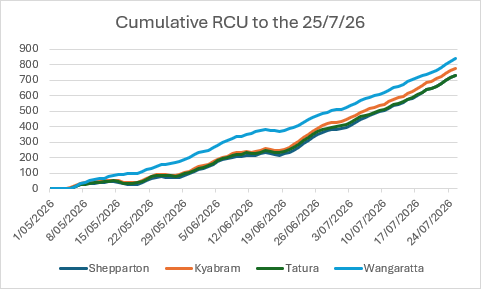
The large difference between the 2 regions is that the Goulburn Valley has a general increase in RCU from late May to tonight.
Regards,
Shane Phillips | Head Chemist - Research & Development
E: shane.phillips@biocentral-labs.com
Stay connected and receive updates, resources and insights—subscribe to our newsletter today.


